
How to Compare Personal Loan Offers
How to Compare Personal Loan Offers: learn how to compare APR, fees, repayment terms, monthly payments, lender reputation, and total borrowing costs before accepting a personal loan.
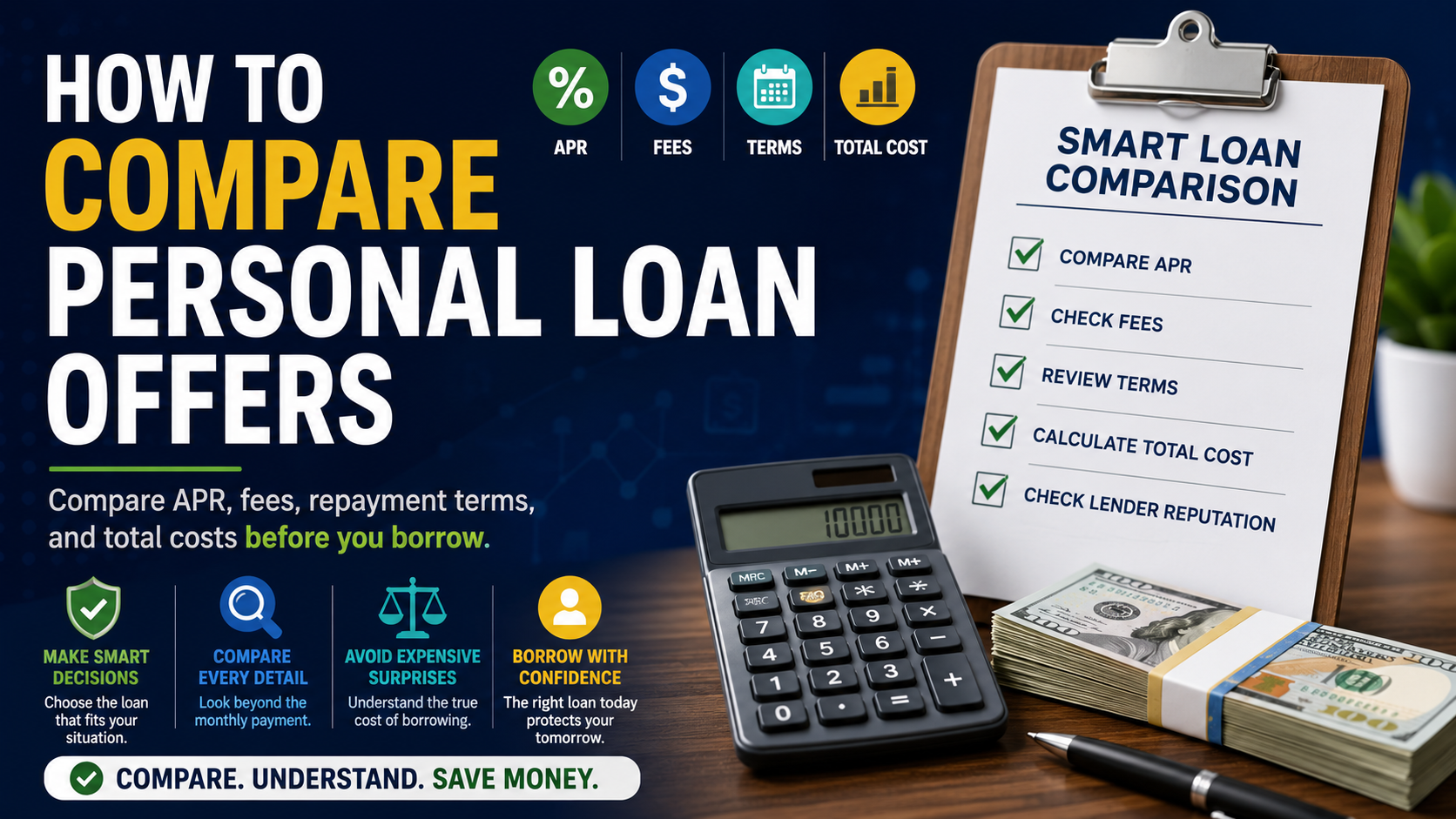
How to Compare Personal Loan Offers
Most Borrowers Compare the Wrong Things First
When people start looking for a personal loan, they often focus on the first number they see. Sometimes it is the monthly payment. Sometimes it is the advertised interest rate. Sometimes it is simply the promise of fast approval.
I understand why that happens. Many loan searches begin during stressful situations. Unexpected bills appear. A car breaks down. An emergency expense shows up. The pressure to find money quickly can make almost any offer look attractive.
But after researching loan products and studying how borrowers compare financial options, I have learned that the first offer is rarely the one that deserves immediate acceptance.
The goal is not just finding a loan. The goal is finding the loan that creates the least financial damage while solving the problem.
Why Comparing Personal Loan Offers Matters
Two personal loans can look nearly identical while producing completely different financial outcomes.
One lender may advertise a lower monthly payment but charge more over time. Another may offer a competitive APR but include additional fees. A third may promote fast approval while hiding expensive borrowing costs inside the repayment structure.
This is exactly why comparing personal loan offers is one of the most important steps before borrowing money.
The Five Numbers I Compare First
Whenever I evaluate a personal loan offer, I focus on five core factors:
- APR;
- Total repayment amount;
- Monthly payment;
- Repayment term;
- Fees and penalties.
These numbers usually reveal more than the marketing headline on the lender's website.
APR Should Be One of the First Things You Check
APR helps borrowers understand the broader cost of borrowing money.
Unlike a simple interest rate, APR often includes certain fees and financing costs associated with the loan. This makes APR one of the most useful comparison tools available.
If two loans have similar amounts and repayment terms, the lower APR often represents the less expensive option.
That does not mean APR should be the only factor you consider, but it should rarely be ignored.
Monthly Payment Is Important but Not Enough
One of the biggest mistakes borrowers make is focusing only on affordability today.
A lower monthly payment may feel safer. However, lower payments often come from extending the repayment period.
The result? The loan becomes more expensive overall.
This is why I always compare the total repayment amount alongside the monthly payment.
Repayment Terms Can Change Everything
The repayment term determines how long you will remain responsible for the loan.
Shorter terms usually produce higher monthly payments but lower total borrowing costs.
Longer terms may reduce monthly pressure while increasing the amount paid over time.
Neither option is automatically better. The best choice depends on the borrower's financial situation and ability to repay comfortably.
Do Not Ignore Fees
Some personal loans include costs beyond the interest itself.
Potential fees may include:
- Origination fees;
- Late payment fees;
- Returned payment fees;
- Administrative fees;
- Early repayment penalties.
A loan with a slightly higher APR but fewer fees may actually be cheaper than a loan that appears less expensive at first glance.
A Practical Loan Comparison Example
Imagine two lenders offer a $10,000 personal loan.
- Loan A: lower monthly payment, longer repayment term.
- Loan B: higher monthly payment, shorter repayment term.
Many borrowers immediately choose Loan A because the payment feels easier.
However, after calculating the total repayment amount, Loan B may actually cost significantly less.
This is why comparing the complete financial picture matters.
Personal Loan Offer Comparison Table
| What to Compare | Why It Matters | What I Would Watch For |
|---|---|---|
| APR | Shows broader borrowing cost | APR much higher than advertised interest rate |
| Monthly payment | Shows short-term affordability | Payment looks low because term is too long |
| Total repayment amount | Shows full cost of the loan | Total paid is far above amount borrowed |
| Fees | Can increase real loan cost | Origination fees, late fees, unclear charges |
| Lender reputation | Affects trust and repayment experience | Complaints, unclear terms, pressure tactics |
Lender Reputation Matters More Than Most People Think
A loan is not just a number. It is also a relationship with a lender.
Before accepting any offer, I would research:
- Customer reviews;
- Licensing information;
- Complaint history;
- Transparency of loan terms;
- Customer support quality.
An attractive loan offer loses value quickly if the lender creates unnecessary problems during repayment.
What I Learned From Studying Loan Searches
While building financial content and studying loan-related searches, I noticed a repeated pattern: people usually search for loans when they are under pressure.
They search for things like fast loan approval, emergency loan online, same day personal loan, loan with bad credit, or money now.
That urgency is real, but it can make borrowers compare speed before cost. And in personal loans, comparing speed first can become expensive.
This is why I believe loan comparison is not just about finding a lender. It is about slowing down long enough to understand what the offer will actually cost.
How I Personally Compare Personal Loan Offers
When I compare personal loan offers, I try to separate the marketing from the math.
My process usually follows this order:
- First, I check the loan amount.
- Then I compare the APR.
- Then I review the total repayment amount.
- Then I check fees and penalties.
- Then I look at the repayment term.
- Only after that do I judge the monthly payment.
- Finally, I ask if there is a safer alternative.
This simple order helps avoid choosing a loan just because it looks fast, easy, or comfortable at first glance.
Common Mistakes People Make When Comparing Loans
- Comparing only monthly payments;
- Ignoring APR;
- Skipping fee disclosures;
- Accepting the first offer;
- Borrowing more than necessary;
- Ignoring repayment risks;
- Focusing only on approval speed.
I see these mistakes repeatedly because urgency often overrides careful analysis.
A Realistic Scenario: The Cheaper Loan May Feel More Expensive at First
Imagine one borrower comparing two personal loan offers.
The first loan has a lower monthly payment and feels easier to manage immediately. The second loan has a higher monthly payment but a shorter repayment term and a lower total repayment amount.
At first, the second loan may feel more uncomfortable. But if the borrower can afford the payment, it may save money over time.
This is the kind of decision that cannot be made by looking at one number alone.
When the Lowest Monthly Payment Can Be a Trap
A low monthly payment can feel like relief, especially during a financial emergency.
But sometimes the lowest payment is created by stretching the loan over a longer period. That can increase the total amount paid, even if the monthly obligation looks easier.
If I were comparing offers, I would ask one direct question: how much will this loan cost from start to finish?
Better Alternatives Before Accepting a Costly Offer
If every personal loan offer looks expensive, I would pause and compare alternatives before accepting the least bad option.
- Check a local credit union;
- Ask the creditor for a payment plan;
- Borrow a smaller amount;
- Delay a non-urgent expense;
- Review nonprofit credit counseling resources;
- Compare secured and unsecured options;
- Improve credit before applying if time allows.
The best borrowing decision is sometimes choosing not to borrow immediately.
Questions I Would Ask Before Accepting Any Personal Loan
- What is the APR?
- What is the total repayment amount?
- Are there origination fees?
- Can I repay early?
- Are there penalties?
- How long is the repayment term?
- Is the lender reputable?
- Does this loan actually solve the problem?
If a lender cannot clearly answer these questions, I would become cautious immediately.
Frequently Asked Questions About Comparing Personal Loans
Should I choose the loan with the lowest APR?
Usually, lower APRs are attractive, but borrowers should also compare fees, repayment terms, total repayment amount, and lender reputation.
Is the lowest monthly payment always best?
No. Lower monthly payments often result from longer repayment periods, which can increase total borrowing costs.
How many loan offers should I compare?
I would compare more than one offer whenever possible. Looking at multiple lenders helps reveal whether an offer is competitive or unusually expensive.
Can comparing loan offers affect my credit?
It depends on the lender and whether the comparison uses a soft credit check or a hard credit inquiry. Borrowers should read the lender’s terms before submitting an application.
Final Guidance: Compare the Whole Loan, Not Just the Headline
Comparing personal loan offers is not about finding the prettiest number on the page. It is about understanding the full cost, the repayment pressure, and the risk attached to each option.
If I were choosing between offers, I would compare APR, total repayment amount, monthly payment, fees, repayment term, lender reputation, and safer alternatives.
The best personal loan offer is not always the fastest or the easiest. It is the one that solves the problem without creating a bigger one later.
Personal Loan Comparison Checklist
| Question | Why It Matters | Warning Sign |
|---|---|---|
| What is the APR? | Shows the broader cost of borrowing. | The APR is hidden or unclear. |
| What is the total repayment amount? | Shows what the loan may cost from start to finish. | Only the monthly payment is emphasized. |
| Are there origination fees? | Fees can reduce the amount received or increase the real cost. | Fees appear only in small print. |
| Can I repay early? | Early repayment flexibility can reduce total interest. | There is a prepayment penalty. |
| Is the lender transparent? | Clear terms reduce surprise costs. | The offer pressures you to decide quickly. |
What I Learned Comparing Loan Content Across Brazil and the United States
While building financial content through projects like CompararBancos.com.br and FupFup Loans, I noticed that the borrower mindset is surprisingly similar across markets.
People usually do not start by searching for technical terms. They search for solutions: fast money, emergency loan, loan approval, credit options, or how to borrow safely.
That taught me something important: a good loan comparison page should not only explain numbers. It should help the reader slow down, compare risks, and avoid decisions made only under pressure.
A Real Example of Two Offers That Look Similar
Imagine two personal loan offers with the same loan amount and almost the same monthly payment.
At first, they may look equal. But after reviewing the details, one loan has a longer repayment term, a higher total repayment amount, and an origination fee deducted from the funds.
This is exactly why I never compare personal loans by one number alone. The full structure matters more than the headline.
My Rule Before Trusting a Personal Loan Offer
My rule is simple: if I cannot understand the total cost, I do not trust the offer yet.
A serious loan offer should make the APR, fees, repayment term, monthly payment, and total repayment amount clear enough for a borrower to compare confidently.
If the offer requires guessing, digging through confusing language, or ignoring unclear fees, I would look for another option before applying.
What Makes a Loan Offer Safer to Compare
A safer loan offer is not always the cheapest offer, but it should be transparent.
- The APR is clearly displayed.
- The repayment term is easy to understand.
- The fees are explained before applying.
- The lender does not promise guaranteed approval.
- The total repayment amount is available or easy to estimate.
- The borrower is not pressured into an immediate decision.
These signs do not guarantee a perfect loan, but they make comparison much easier and safer.
What I Would Do If Two Offers Look Almost Equal
If two personal loan offers look almost equal, I would not choose randomly.
I would compare the details most borrowers ignore:
- Which lender has clearer terms?
- Which loan has fewer fees?
- Which repayment term fits the budget better?
- Which lender has better reputation signals?
- Which option leaves more room for financial emergencies?
When numbers are close, transparency and repayment flexibility become even more important.
The Biggest Lesson About Comparing Personal Loans
The biggest lesson I learned from studying loan searches is that borrowers often compare offers too late.
They apply first, get excited about approval, and only then begin reading the full terms.
I would reverse that process. Compare first, understand the cost first, then decide whether applying makes sense.
That small change can prevent many expensive borrowing mistakes.