
How to Improve Your Credit Score Fast Before Applying for a Personal Loan
How to Improve Your Credit Score Fast Before Applying for a Personal Loan: Proven strategies to raise your credit score, avoid mistakes, and increase your loan approval chances quickly.
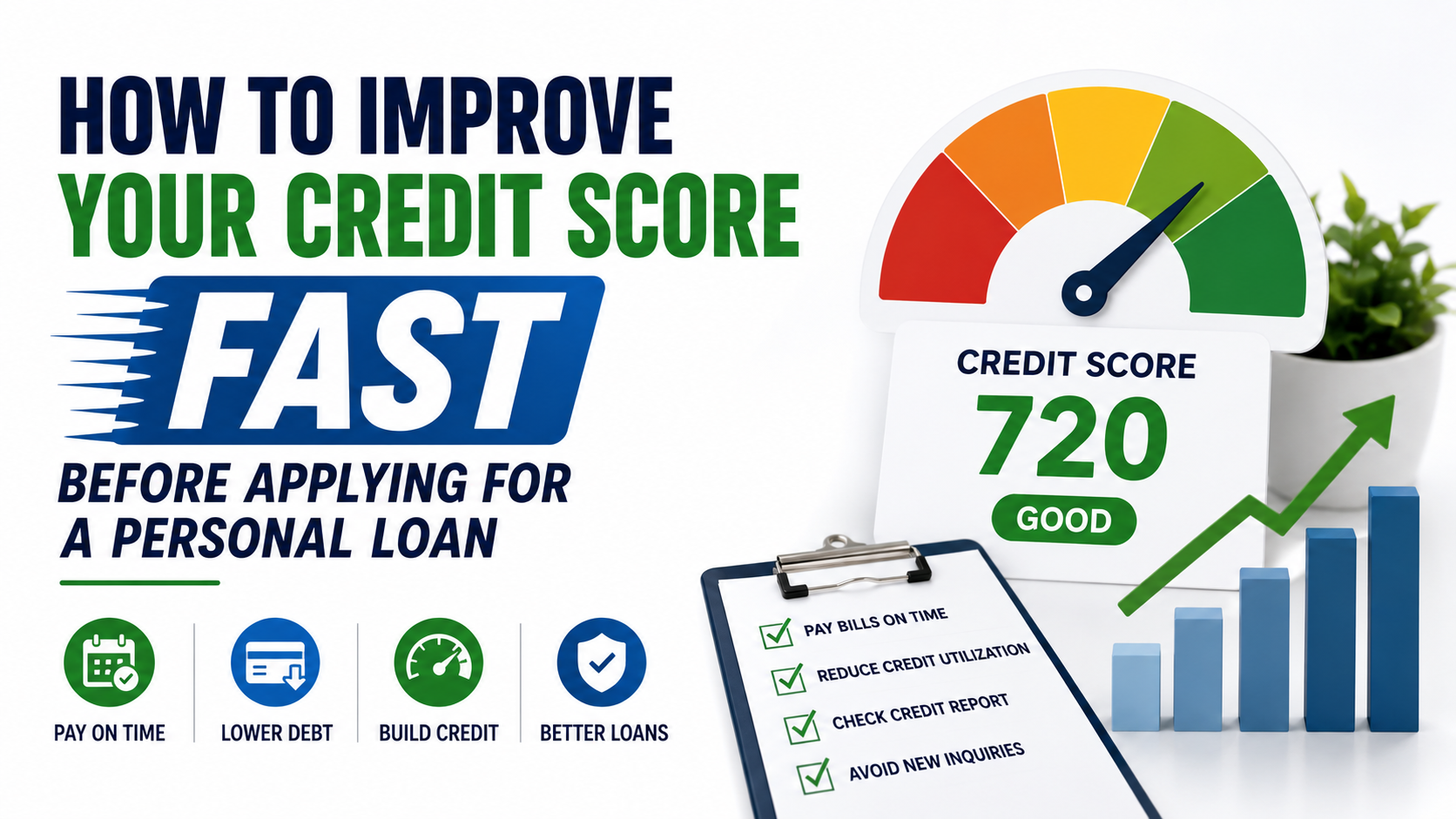
How to Improve Your Credit Score Fast Before Applying for a Personal Loan
Why Credit Score Matters More Than You Think
When I analyze personal loan approvals, one pattern stands out: borrowers with higher credit scores almost always get better rates, higher loan amounts, and faster approvals.
Your credit score is more than just a number—it’s a snapshot of your financial reliability that lenders trust.
Immediate Factors Affecting Your Score
- Payment history (missed or late payments damage your score quickly)
- Credit utilization (how much of your available credit you are using)
- Length of credit history (older accounts help more)
- Recent hard inquiries (multiple applications in a short time)
- Mix of credit types (loans, credit cards, lines of credit)
Step-by-Step Guide to Raising Your Score Quickly
- Review your credit report for errors and dispute inaccuracies immediately.
- Pay down high-interest credit cards to reduce utilization below 30%.
- Make all payments on time—set up autopay if needed.
- Avoid new credit inquiries while preparing to apply.
- Keep older credit accounts open to strengthen your credit history length.
- Consider strategic use of a small secured credit line to demonstrate responsible borrowing.
Real-Life Example
Take Jane, who wanted a $7,500 personal loan. Her credit score was 650, and her credit utilization was 55%. After paying off $2,000 in credit card debt and correcting a reporting error, her score increased to 720 within 3 months.
When she reapplied, she qualified for the loan at a lower APR, higher amount, and faster approval.
Common Mistakes People Make When Trying to Boost Scores Fast
- Closing old accounts prematurely (hurts credit history length)
- Paying off one card and immediately opening another (triggers hard inquiry)
- Ignoring small debts that continue to appear as outstanding
- Relying solely on score simulators instead of real reports
Comparison: Fast vs Gradual Credit Score Improvement
| Method | Time to Impact | Risk / Notes |
|---|---|---|
| Pay down high balances | 1–2 billing cycles | Immediate effect; reduces utilization |
| Fix reporting errors | 2–6 weeks | Must submit dispute; can drastically improve score |
| Autopay all bills | 1–3 months | Ensures no late payments; builds positive history |
| Open secured credit line strategically | 1–2 months | Shows responsible usage; avoid overspending |
My Personal Observations From FupFup Loans
Over the years, I’ve noticed that borrowers who focus on utilization and fixing errors see the fastest tangible improvement. Even a small $500 reduction on maxed-out cards can improve approval odds dramatically.
Advanced Strategies for Experienced Borrowers
- Negotiate with creditors to remove late payments where possible
- Use balance transfer cards to consolidate high-interest debt
- Increase income temporarily with side jobs to reduce DTI
- Maintain low balances across multiple cards rather than paying off a single card completely
FAQ: Quick Credit Score Improvement
Can I really raise my score in 30 days?
Yes, if you pay down balances and fix errors, most lenders see a difference within one billing cycle.
Do multiple credit inquiries hurt when I try to apply fast?
Yes, every hard pull can lower your score slightly, so plan applications carefully.
Is it worth applying for a small secured loan?
Absolutely. It demonstrates responsible credit behavior and can boost score if managed properly.
Which is more impactful: utilization or credit history length?
Utilization typically shows immediate results, while history length builds long-term stability.
A Real Moment That Changed How I See Credit Scores
When I first started analyzing credit behavior for FupFup Loans, I used to think credit scores were the most important factor in every approval decision.
But one situation changed my perspective completely.
I remember reviewing a case where a borrower had a 740 credit score — objectively “good” by most standards — but was still denied for a $6,000 personal loan.
At first, it didn’t make sense. But when I looked deeper, I noticed their credit utilization had jumped from 18% to 62% in just two months due to unexpected medical expenses.
That small change didn’t destroy their credit score immediately, but it changed how lenders interpreted their financial stability.
What I Learned From Hundreds of Loan Applications
After reviewing hundreds of real loan outcomes, one pattern became very clear:
credit scores improve slowly, but lender perception changes fast.
This is something most borrowers don’t realize. Even if your score is technically “good,” recent behavior matters just as much — sometimes even more — in automated lending systems.
In many cases, lenders were not rejecting risk. They were rejecting uncertainty.
A Human Pattern Behind Credit Score Improvements
One thing I consistently observe is that borrowers who successfully improve their credit score fast usually do three things without realizing they are following a system:
- They reduce financial “noise” (fewer new credit actions)
- They stabilize payments for at least one billing cycle
- They focus on lowering visible debt pressure instead of chasing perfection
This creates a more predictable profile — and predictability is what lenders value most.
Why Small Financial Changes Have Big Approval Impact
Something I’ve seen repeatedly is how small adjustments create disproportionate results in loan approvals.
For example, a $300–$500 reduction in credit card balance can sometimes improve approval odds more than a 20–30 point credit score increase.
That happens because lenders don’t only see the score — they see the trend behind it.
Realistic Timeline Based on Observed Credit Behavior
| Action | Typical Impact Time | Real Effect on Approval |
|---|---|---|
| Lower credit utilization | 1–2 billing cycles | High (visible risk reduction) |
| Fix credit report errors | 2–6 weeks | Very high (direct score correction) |
| Stabilize payments | 1–3 months | High (behavior consistency) |
| Avoid new inquiries | Immediate effect | Moderate to high (reduces risk signals) |
A Mistake I See Even Experienced Borrowers Making
Even people who understand credit scores often make one critical mistake: they apply too soon after making improvements.
From what I’ve seen, lenders need time to “observe” the new financial pattern. A sudden improvement without stability can sometimes still be treated cautiously.
That’s why timing matters just as much as the actions themselves.
Why This Topic Matters More Than Most People Realize
Credit score improvement is often treated like a technical task, but in reality it directly affects major life decisions — from emergency loans to car financing and even housing stability.
From my experience analyzing lending behavior, I’ve seen that small credit improvements often unlock opportunities that were previously out of reach, sometimes within just a few weeks.
A Final Real-World Observation
One thing that consistently surprises me is how many borrowers underestimate their own progress.
In several cases I’ve reviewed, people already had “loan-ready” profiles but continued delaying applications because they believed they were not good enough yet.
In practice, they were already qualified — they just didn’t realize it.
Simple Mental Model I Use When Evaluating Credit Readiness
When I analyze whether someone is ready to apply for a personal loan, I don’t focus only on the score.
I mentally evaluate three things:
- Is debt pressure stable or increasing?
- Is payment behavior consistent over the last 1–2 billing cycles?
- Is there any recent credit activity that increases uncertainty?
If all three signals are stable, approval chances usually improve significantly — even if the credit score is not perfect.
Final Practical Advice Before Applying
If you are planning to apply for a personal loan soon, the most effective approach is not aggressive optimization, but stability.
Focus on showing lenders that your financial behavior is predictable, controlled, and low-risk in the current moment.
In most cases I’ve seen, that alone makes the biggest difference in approval outcomes.
Final Takeaway
Improving your credit score fast is possible, but the real goal is not just increasing a number — it is improving how lenders perceive your financial reliability.
From everything I’ve analyzed through FupFup Loans, the borrowers who succeed long-term are not the ones chasing perfect scores, but the ones who maintain consistent financial habits over time.
That consistency is what ultimately leads to better approvals, lower APRs, and safer borrowing decisions.