
What Is Debt-to-Income Ratio (DTI) and Why It Matters for Loans
What Is Debt-to-Income Ratio (DTI) and Why It Matters for Loans: Learn how DTI affects loan approval, borrowing limits, lender risk decisions, and how to improve your financial profile.
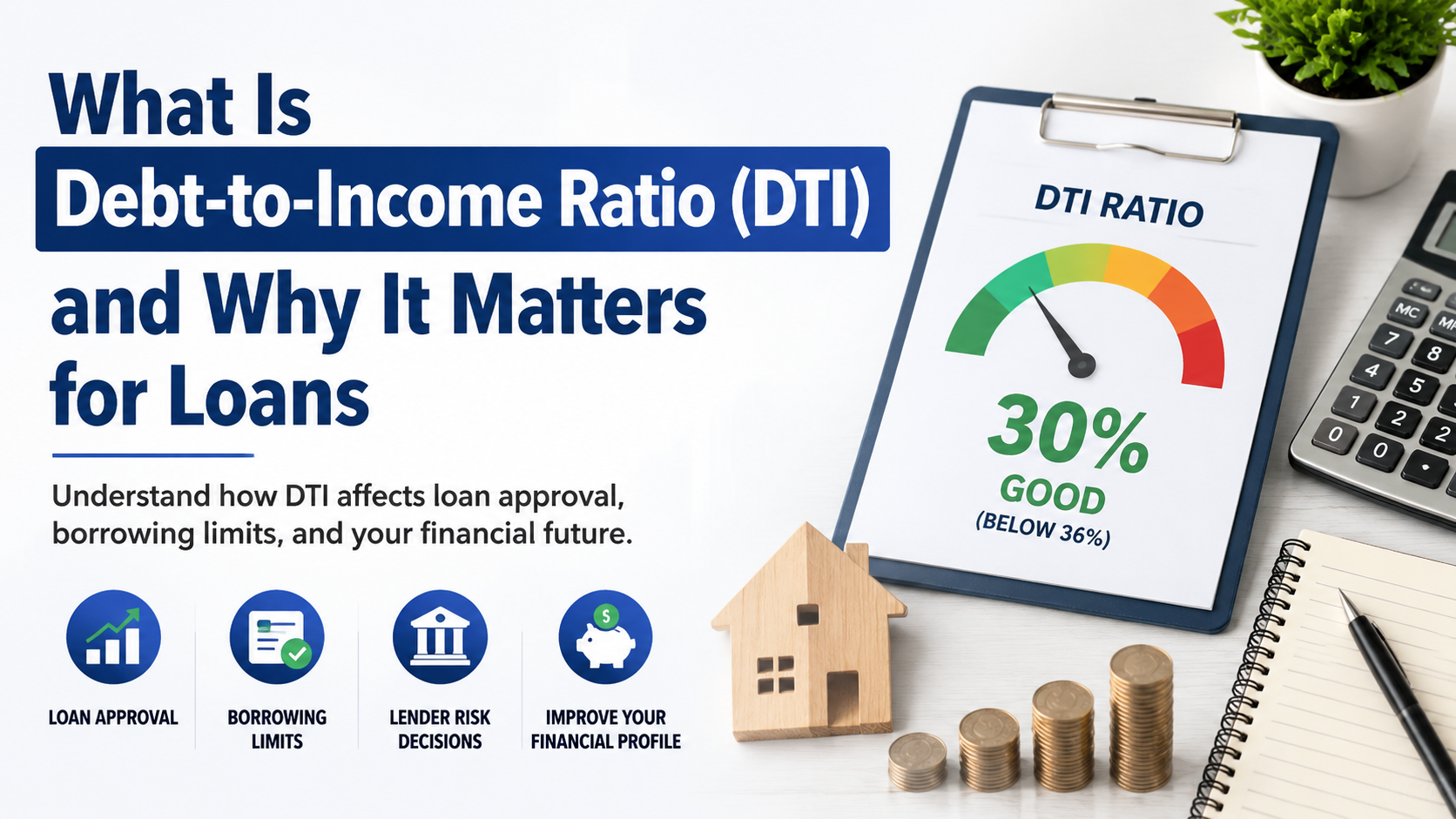
What Is Debt-to-Income Ratio (DTI) and Why It Matters for Loans
Why DTI Is One of the Most Important Loan Approval Factors
When I started analyzing how lenders evaluate personal loan applications, I noticed something very consistent: even people with good credit scores get denied when their debt-to-income ratio is too high.
DTI is one of those metrics that quietly decides whether your income is actually enough to support new debt.
Unlike credit score, which looks at your history, DTI focuses on your current financial pressure.
What Debt-to-Income Ratio (DTI) Actually Means
Debt-to-Income Ratio (DTI) measures how much of your monthly income goes toward paying debts.
In simple terms, it answers this question: “How much of your money is already committed before you even apply for a new loan?”
It is calculated using total monthly debt payments divided by gross monthly income.
Simple DTI Example
If someone earns $4,000 per month and pays $1,200 in existing debts (credit cards, car loan, etc.), their DTI is:
DTI = 1,200 ÷ 4,000 = 30%
This means 30% of their income is already committed before any new loan is added.
DTI Ranges and What Lenders Usually Think
| DTI Range | Risk Level | Typical Loan Outcome |
|---|---|---|
| Below 20% | Low risk | Strong approval chances, better loan terms |
| 20% – 36% | Moderate risk | Normal approval range for most lenders |
| 37% – 49% | High risk | Stricter review, possible higher APR |
| 50%+ | Very high risk | High rejection probability |
Why DTI Can Matter More Than Credit Score
One thing that surprises many borrowers is that a high credit score does not guarantee approval if DTI is too high.
Lenders care about repayment capacity in the present moment. Even with a strong credit history, too much existing debt signals financial stress.
Real-World Borrower Comparison
- Borrower A: Credit score 720, DTI 25%
- Borrower B: Credit score 780, DTI 55%
In many lending systems, Borrower A is more likely to get approved because their income has more room for new debt obligations.
What Counts as Debt in DTI Calculation
- Credit card minimum payments
- Personal loans
- Car loans
- Student loans
- Mortgage payments (if applicable)
Expenses like utilities or groceries are not included because DTI focuses strictly on debt obligations.
How Lenders Use DTI in Real Decisions
Lenders use DTI to estimate whether adding a new loan will push a borrower beyond safe repayment limits.
Even if everything else looks good, a high DTI can reduce loan amounts, increase APR, or lead to rejection.
Common Mistakes Borrowers Make With DTI
- Ignoring small debts that still count in calculations
- Thinking only credit score matters
- Applying for new loans without reducing existing obligations
- Underestimating credit card minimum payments
How to Improve Your DTI Ratio
- Pay down high-interest debt first
- Consolidate multiple debts into one lower payment
- Avoid new unnecessary credit obligations
- Increase income if possible (side income or stable job growth)
Personal Observation: How DTI Impacts Borrower Stress
From years of running FupFup Loans, I've noticed that borrowers with DTI above 40% often feel trapped. Even if their credit score is high, lenders see them as financially stressed, which can limit approval options or increase APR.
One thing I personally advise: calculate your DTI before applying, and don’t assume a good credit score will override high existing obligations.
Real-Life Example: Improving DTI to Get Approved
Take John, who wanted a $10,000 loan. His income was $5,000/month and debts were $2,500, making his DTI 50%. His application was rejected.
After paying down $1,000 in credit card debt, his DTI dropped to 30%. Reapplying, he was approved at a reasonable APR. Small changes can have huge impact.
Comparison: DTI Thresholds by Lender Type
| Lender Type | Preferred Max DTI | Effect on Approval |
|---|---|---|
| Banks | 36% | Strict review; higher DTI often leads to rejection |
| Credit Unions | 40% | Flexible but still cautious; may require smaller loan |
| Online Lenders / Fintech | 45% | Can approve slightly higher DTI, but APR may be higher |
Practical Steps to Improve Your DTI
- Pay off high-interest credit cards first
- Consolidate multiple small debts to reduce monthly payments
- Delay new loan applications until DTI improves
- Increase monthly income with side work or overtime if possible
- Review DTI with a financial advisor for personalized strategy
FAQ: DTI and Loan Approvals
Q: Can a high DTI ever be approved?
A: Yes, some lenders may approve higher DTI borrowers, but they often increase the interest rate or reduce the loan amount.
Q: Should I focus more on credit score or DTI?
A: Both matter. Credit score shows your history, DTI shows current financial capacity. Lenders consider both together.
Q: How often should I check my DTI?
A: Check it before every major loan application to ensure you are within safe borrowing limits.
Q: Does DTI affect other financial decisions?
A: Absolutely. High DTI can impact mortgage applications, credit card limits, and refinancing options.
Deeper Insight: Why Lenders Treat DTI as a “Risk Pressure Signal”
One thing I noticed analyzing lending behavior is that DTI is not just a math formula for lenders — it is a stress indicator.
When your monthly obligations take a large portion of your income, lenders assume that even small financial shocks (like unexpected bills) can affect repayment ability.
This is why DTI often has more weight than people expect, especially in automated online approvals.
Hidden Detail Most Borrowers Miss About DTI
A common misunderstanding is that only large loans affect DTI. In reality, even small recurring payments matter.
- Small credit card minimum payments
- Buy-now-pay-later installments
- Car insurance financing
- Student loan payments (even deferred ones in some systems)
These smaller obligations accumulate and quietly increase your risk profile.
Scenario-Based Comparison: Same Income, Different Outcomes
| Profile | Income | Total Debt | DTI | Result |
|---|---|---|---|---|
| Borrower A | $4,500 | $900 | 20% | Fast approval, low APR |
| Borrower B | $4,500 | $2,200 | 48% | Higher rejection risk or strict conditions |
What I’ve Seen in Real Loan Evaluations
From observing patterns across financial products, one consistent behavior stands out: lenders prefer borrowers with “room to breathe” financially.
Even if two applicants have similar credit scores, the one with lower monthly debt pressure almost always receives better terms.
This is why improving DTI is often more effective than chasing small credit score increases.
Advanced Strategy: How Experienced Borrowers Reduce DTI Faster
- Paying off the smallest debts first to reduce number of active obligations
- Refinancing high-interest debt into longer-term lower payments
- Consolidating multiple credit lines into a single payment
- Avoiding new credit commitments during loan preparation phase
These strategies are commonly used by borrowers trying to qualify for better APR tiers.
Final Takeaway: DTI Is About Financial Flexibility
At its core, DTI is not just a lender metric — it reflects how flexible your finances are in real life.
From my experience analyzing loan approvals, the most successful borrowers are not just those with high income or strong credit scores, but those who maintain balanced debt levels that give them financial breathing space.